Practice · original writing prompts
12 spiritual journaling prompts for the end of a day.
Choose one question. Bring it to one ordinary moment from today. Write what happened, notice your response, and leave yourself one small action for tomorrow.
Use one prompt, not all twelve.
A spiritual journaling prompt is a starting question for examining your inner life through something that actually happened. It does not need a grand answer. A few lines about a conversation or a repeated response may give you more to work with than a page of general intentions.
These twelve questions were written for this guide. They are not quotations from spiritual teachers or a list of the questions inside our book. Use an ordinary notebook, and keep the question you chose beside the date. If you are new to this, our guide to starting a spiritual journal walks through a complete evening entry.
This is a writing exercise alongside an existing meditation practice, not instruction in meditation techniques or professional care.
Attention after meditation.
1. Where did the attention I brought to meditation appear again during the day?
Look for a particular action: listening to a sentence, finishing a task, noticing the urge to hurry. Describe the moment before deciding what it means.
2. Which thought kept returning, and what did I do when it returned?
You do not have to resolve the thought in tonight's entry. Distinguish the thought itself from the action that followed it.
3. When did I remember what matters to me without needing a reminder?
Choose something small enough to name. If no example comes, write that honestly rather than supplying an ideal version of the day.
Conduct and other people.
4. In which conversation was I preparing my answer instead of listening?
Return to one exchange, not a verdict about whether you are a good listener. What would finishing the other person's sentence have allowed you to hear?
5. What useful thing did I do that nobody needed to notice?
Record the action without making it larger. Consider whether you would be willing to repeat it without acknowledgement.
6. Is there a word or action from today that I should repair?
If there is, separate the repair you can actually make from the explanation you would like someone to accept. Leave space for uncertainty.
A habit and its opposite.
7. What did I try to control that was not mine to decide?
Name the situation and your part in it. A useful entry can distinguish responsibility for your action from control over somebody else's response.
8. What would the opposite of one repeated reaction have looked like?
Stay with a real example. If the reaction was impatience, describe the patient action in that setting rather than writing only the word patience.
9. Which task did I postpone, and what was my first reason?
Write down the reason before polishing it. Then ask whether a smaller version of the task would have been possible.
One step for tomorrow.
10. What is one action I can recognise when tomorrow gives me the opportunity?
Make it observable: let a sentence finish, begin the postponed task, keep one promise. An action is easier to return to than an instruction to become different.
11. What remains unfinished that I do not need to force into an answer tonight?
Give it a sentence, even an incomplete one. Your journal can hold an open question without turning it into a lesson.
12. Which quality do I want to practise in one ordinary situation tomorrow?
Put the quality beside a place or encounter: patience during a conversation, care while finishing work, honesty when answering a question. Keep the scale human.
When you want a structure to return to.
A blank notebook is enough for these prompts. If you prefer a printed structure, Who Am I Becoming? is our English-language guided spiritual journal for 108 nights. Each night includes a passage, an introspection chart, one step for tomorrow and room for your own words.
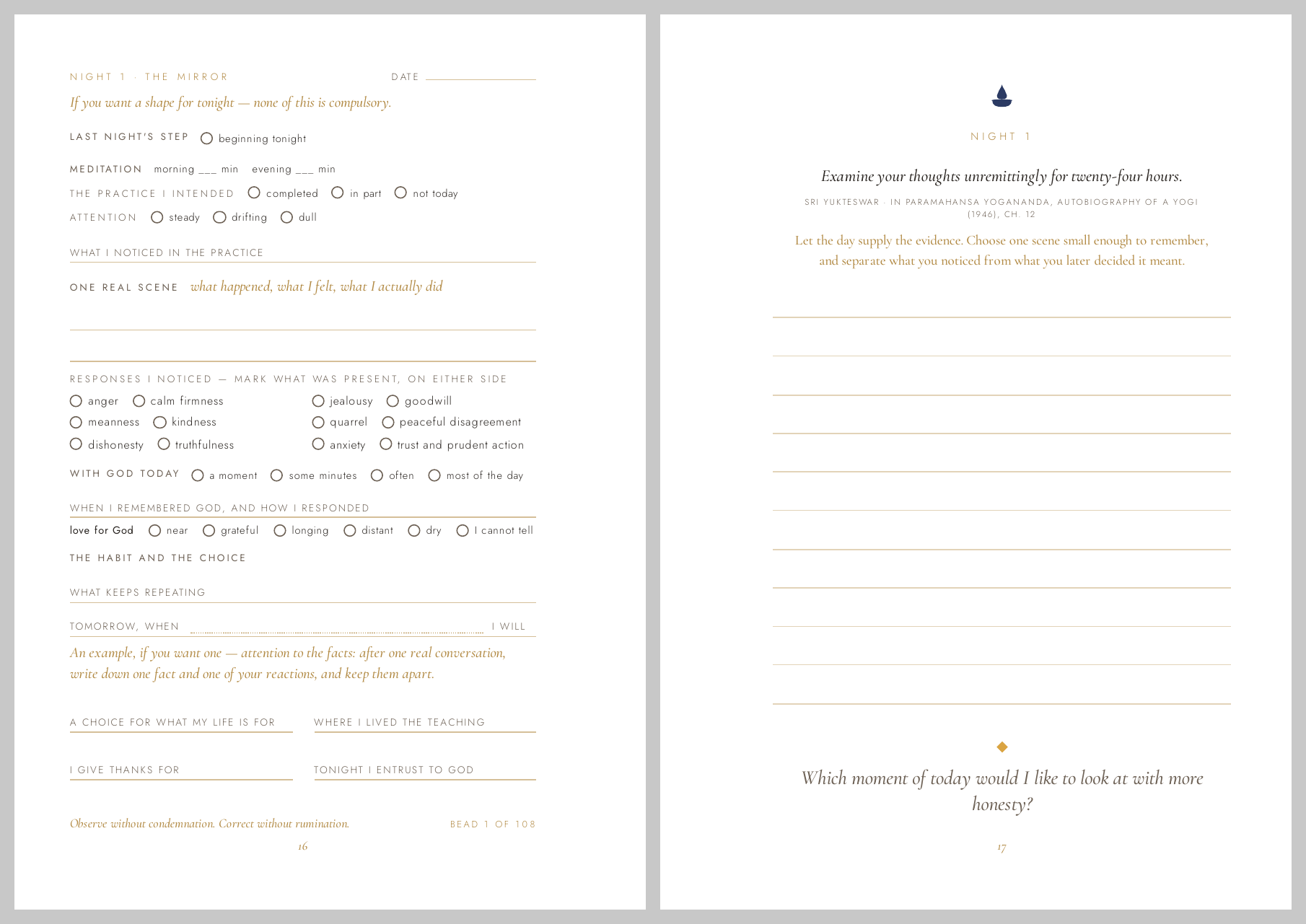
Read the actual pages before choosing.
Both navy linen hardcover editions contain the same 108 nights, quotations and questions. The full edition has a colour interior on white paper, brief reflections and a question index. The concise edition has a black-and-white interior on cream paper and less reading.
Preview the original journal pages →Compare the full and concise editions. Printed on demand and shipped by Lulu.