Practice · an evening writing guide
How to start a spiritual journal.
Begin with one moment from the day. Look at it honestly, write what you notice, and choose a small action for tomorrow. A notebook and a question are enough to start.
Looking for a printed journal? Preview the original pages of our 108-night spiritual journal, then compare the two hardcover editions. The book is in English.
What is a spiritual journal?
A spiritual journal is a place to examine your inner life and how it shows up in ordinary actions. You might write about meditation, your relationship with God, a passage you have read, or the distance between a value you hold and something you did today.
It can include events, but it need not record everything that happened. The focus is the attention you bring to an event: the motive, the reaction, the habit, and the possibility of responding differently.
This guide offers one approach to evening introspection alongside an existing meditation practice. It is a writing practice, not instruction in meditation or Kriya techniques.
An evening practice in four steps.
1. Begin with something specific.
Choose a short passage from a source you know, or begin with a question. If you copy a passage, record its author, title and location so you can return to it. You do not have to find a new teaching every evening.
2. Describe one moment from the day.
A conversation, an interruption or a task you avoided is enough. Write what happened before interpreting it. A concrete description gives you something to examine; a general verdict about your character leaves much less room to work.
3. Notice the response and its opposite.
What did you do? What were you trying to protect or obtain? Name the response as precisely as you can. If you noticed impatience, consider what patience would have looked like in that same situation. Keep the reflection close to the event.
4. Choose one action for tomorrow.
Make it small enough to recognise when the opportunity arrives. Then leave room to write freely. The next step and the open page serve different purposes: one gives the reflection a direction; the other lets you notice what does not fit neatly into a chart.
An example written for this guide
During a conversation, I interrupted before the other person finished. I wanted to defend my explanation. Tomorrow, when I feel that urge, I will let the sentence end before replying.
A spiritual journaling prompt to begin with.
The opening question in Who Am I Becoming? asks:
Which moment of today would I like to look at with more honesty?
You can use that question with an ordinary notebook. Begin with a few lines about the moment itself. If more comes, keep writing. If little comes, leave the page as it is and return another evening.
For other starting points, try our 12 spiritual journaling prompts for evening reflection. Those questions were written for the guide; they are separate from the 108 questions in the book.
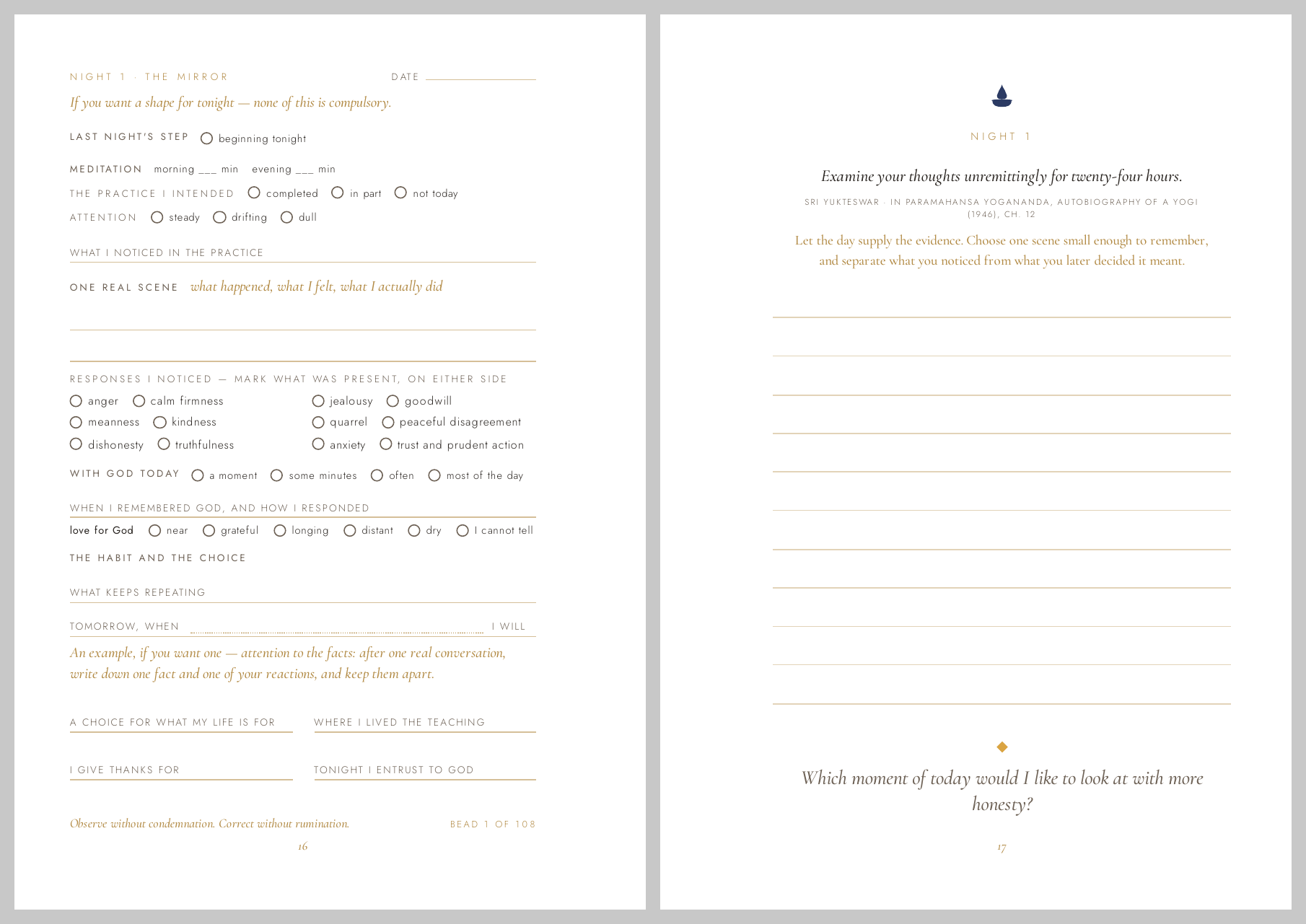
The chart in the book brings together meditation, conduct, God, a habit and its opposite quality, followed by a step for tomorrow. The facing page gives the reflection room to continue in your own words.
A guided journal or a blank notebook?
A blank notebook gives you complete freedom over the questions, format and pace. It is a good place to begin if you already know what you want to explore.
A guided spiritual journal supplies a recurring structure. Choose one by looking at an actual page: do its questions invite the kind of attention you want to practise? Is there enough room for your own writing? Does its language fit the way you approach your spiritual life?
Inside Who Am I Becoming?
Our journal follows 108 nights in twelve rounds of nine, with a look back after each round. Both hardcover editions contain the same quotations and questions. The full edition adds a brief reflection beneath each quotation and an index of the questions; the concise edition has less reading and more writing space.
Explore the two editions →Return to what you have written.
After several entries, read them together. Look for a repeated situation, a response that has changed, or an action you intended but did not take. Let a specific example lead to the next question.
You do not need to turn every entry into a lesson. Some evenings may hold uncertainty or a sentence you cannot finish. The page can keep that too.